Mobile Application
 Mobile Application Overview
 Mobile Application Overview
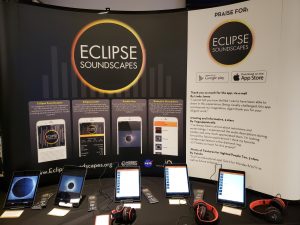
The Eclipse Soundscapes Mobile Application was originally created to make the 2017 “Great American Eclipse” usable by everyone, with a special focus on people who are blind or have low vision. Because eclipses are often perceived as primarily visual events, the BLV community has historically been excluded from fully participating. The app was designed from the start using Universal Design for Learning (UDL) principles so that users of all abilities could learn together and share a multisensory eclipse experience. It features rich audio descriptions, an interactive “rumble map” for exploring eclipse features through touch and sound, and clear explanations of both annular and total solar eclipses.
How the App Has Evolved
The first version (Eclipse Soundscapes 1.0) launched in 2017 as part of NASA’s Heliophysics Education Consortium, offering a multisensory experience. A later update (Eclipse Soundscapes 2.0) was completed to support the 2020 solar eclipse, improved the readability of the learning materials for general audiences, and expanded the app to be fully bilingual in English and Spanish. This update was also supported by NASA’s Heliophysics Education Consortium and continued the project’s commitment to thoughtful, user-centered design that supports many different ways of learning and engaging.
Current Funding Status
The mobile app remains a valuable educational resource, but it is not currently funded or being updated for upcoming eclipse events. It operates independently from the Eclipse Soundscapes participatory science project, which focused on community-based data collection and multisensory observing for the 2023 and 2024 solar eclipses.
Eclipse Soundscapes Apps Are Free to Users
The Eclipse Soundscapes Mobile Application is free of charge to users. Read the Mobile Application Privacy statement here.
Although the app remains available in the Apple App Store and Google Play Store, it is not currently funded, so we do not have the resources to update or maintain it on an ongoing basis. We hope it remains available for as long as possible, as its educational content continues to support eclipse learning for the general public, educators, and families.
Download it in the Apple App Store

Available on Google Play

PROJECT ORIGINS
The idea for Eclipse Soundscapes came from Dr. Henry “Trae” Winter, a solar astrophysicist with a passion for public science engagement. While developing solar wall exhibits for museums, Winter noticed that many visitors, especially people who are blind or have low vision, were not fully supported in exploring the content. Some exhibits offered only the name of the object in braille, and others did not provide any features intended for these visitors.
Winter began to imagine an astrophysics project that would use sound, touch, and other sensory approaches so more people could participate meaningfully, including those who do not experience space science visually. The “Great American Eclipse” of August 2017 presented a perfect opportunity to bring this idea to life. A team of astrophysicists, mobile app developers, an educator, members of the BVI community, and specialists in media and audiovisual design worked together to create the Eclipse Soundscapes Mobile Application.
TOUCH AN ECLIPSE
 TOUCH AN ECLIPSE
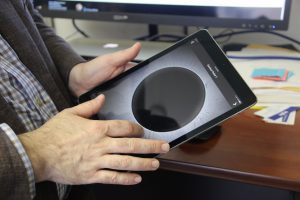
The Eclipse Soundscapes’ app features an interactive “rumble map,” which uses a smartphone’s touch screen and vibrational feedback to demonstrate the physical qualities of an eclipse. The rumble map displays photos of the eclipse at various stages. When users touch the image, the app reads the greyscale value of a pixel underneath their finger, and vibrates the phone with a strength relative to the brightness of the section. As users move their fingers around the Sun, their smartphone will vibrate more. As they move their fingers into the dark spaces blocked by the Moon, the vibration will diminish and disappear.